
Instagram Competitor Analysis: Compare Two Accounts' Followers Side by Side
Two accounts with the same follower count can share everyone or nobody. How to compare two Instagram audiences and turn the overlap into a prospect list.
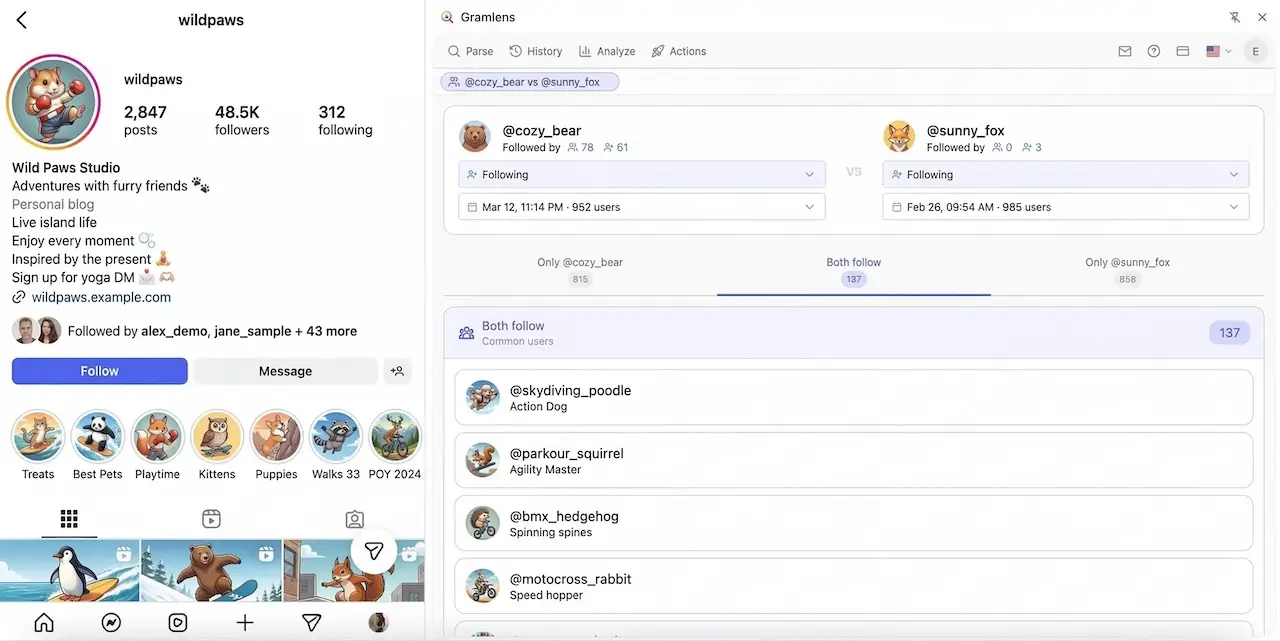
Two barbershops in the same city, 8,240 followers and 8,120 followers. On the profile page they look like the same business at the same stage. They are not: one of them shares 14 followers with you and the other shares 900, and those two situations call for completely opposite decisions — one is a collaborator, the other is a competitor for the same room.
The follower count cannot tell you which is which. The follower list can. This guide covers how to compare two Instagram accounts' audiences, what each part of the result is actually good for, and the honest limits of doing it — including the ones that stop this from being a magic prospecting button.
Why the overlap is the number that matters
Most competitor analysis on Instagram stops at metrics you can read off a profile: follower count, post frequency, average likes. Those tell you how big someone is and roughly how engaged. They tell you nothing about whether their audience and yours are the same people — which is the question underneath almost every decision you'd make with the data.
- Paying an influencer whose followers already follow you is buying reach you own.
- A cross-promotion with an account that shares 90% of your audience is two posts to the same room.
- A competitor's followers who have never encountered you are the closest thing Instagram offers to a qualified prospect list: they raised their hand for the category, just not for you.
All three questions are the same operation — take two follower lists and intersect them — and none of them are answerable from the outside of a profile.
What Instagram gives you, and where it stops
Open any profile and Instagram will show you one hint: Followed by @someone, @someone_else and 19 others. That's the overlap between your following and their followers, truncated to a number and a couple of names.
It's genuinely useful and completely unusable at scale. You cannot see the full list, you cannot export it, and it only answers one direction of the question. There is no view anywhere in the app for "which of my followers also follow this account", and no API that exposes it. To get the full answer you need both lists as data.
Comparing two accounts, step by step
The Gramlens Chrome extension does the intersection locally on lists you have parsed. Nothing is queried live at comparison time, and no Instagram password is involved at any point — it reads through the session in the tab you already have open.
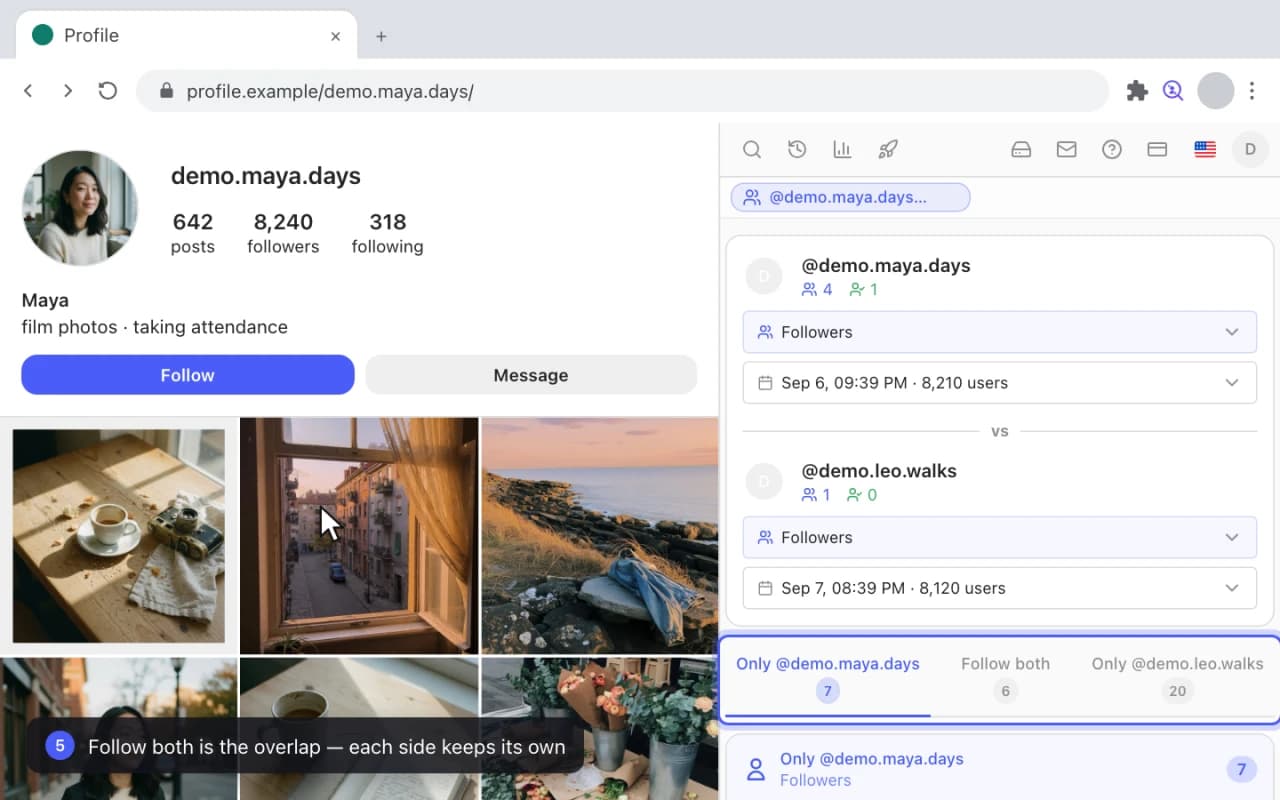
1. Parse the first account
Open the profile on instagram.com, click the Gramlens icon, and run a Followers parse. This works on any public account, and on private accounts you already follow. It does not work on private accounts you don't — the extension sees exactly what your session sees, and no more.
The output is a dated snapshot saved to History. If you also want the file, the same run exports to CSV, Excel or JSON — how to export Instagram followers to CSV covers the export side in full.
2. Parse the second account
Same thing on the other profile. This is the step people underestimate on large accounts: two 8,000-follower lists is the bulk of the work, and it's why the free plan's 500-record parsing cap is the real constraint on this feature rather than the comparison itself.
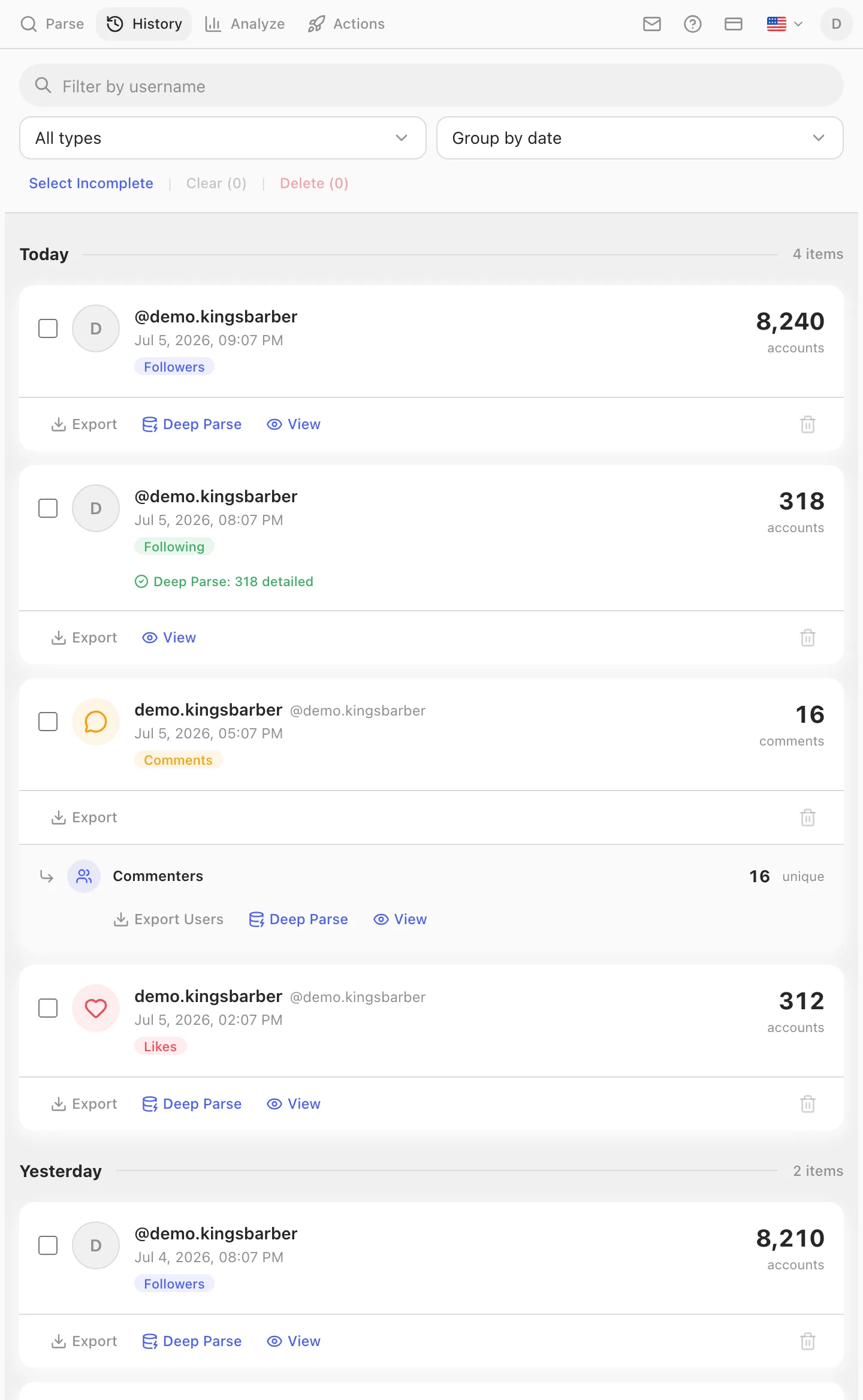
3. Pick the two accounts in Analyze
Open the Analyze tab, put one account in each compare slot, and run it. Each side independently chooses its list type and its snapshot date, which is worth pausing on — it means you are not limited to followers-versus-followers.
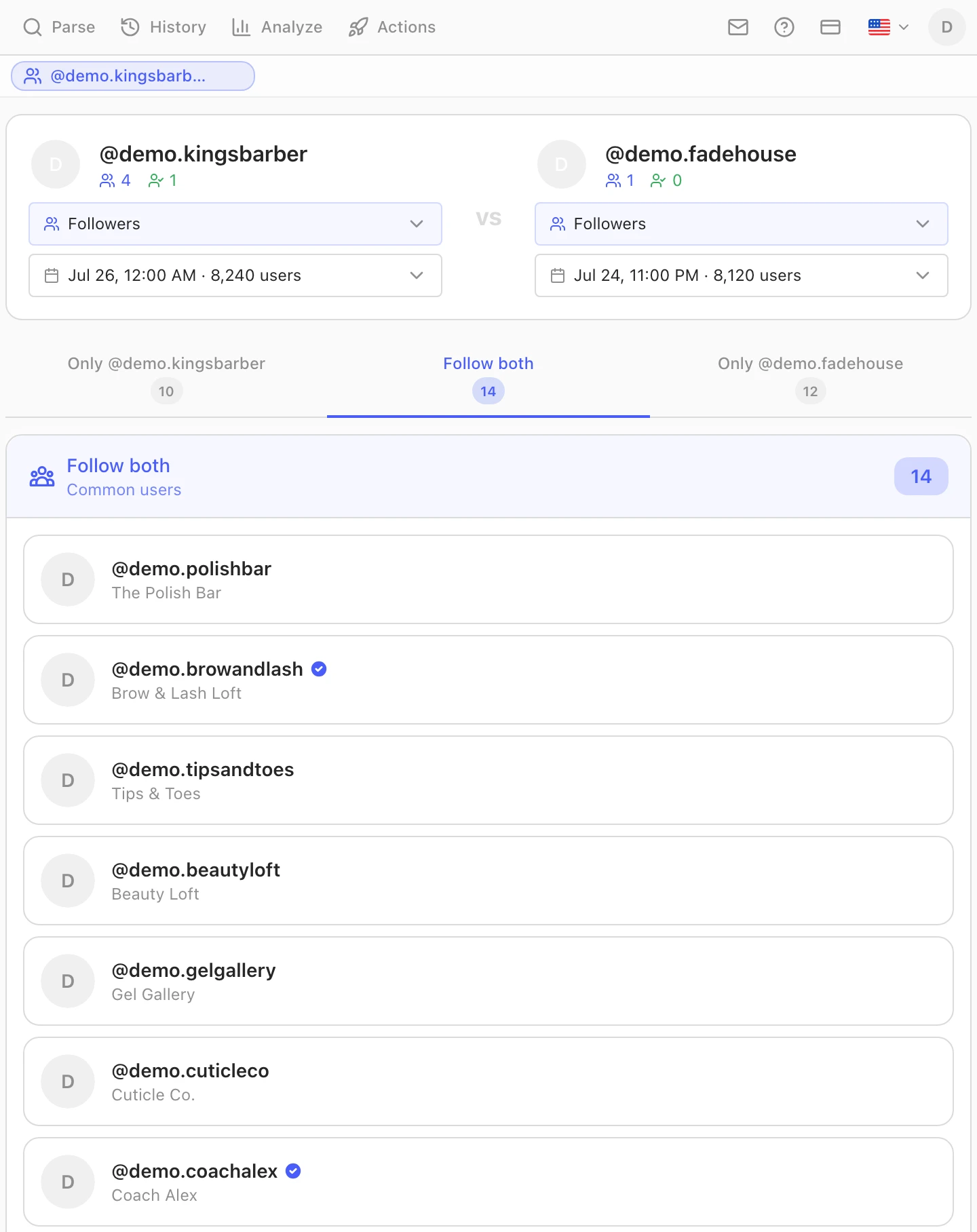
4. Read the three tabs
The result is a set operation rendered as three counted tabs, and each one answers a different question.
- Only @them — accounts in their audience and not in yours. The prospect list.
- Follow both — the shared audience. How much of a collaboration you would already be paying for.
- Only @you — yours alone. What you actually bring to a swap.
5. Try the cross-type comparison
Both sides can be set to followers or following, and mixing them is where the more interesting questions live:
- Your following vs their followers. Which accounts you already follow are in their audience — a warm-intro map before you pitch a collaboration.
- Their following vs their followers. Who they follow that doesn't follow them back. It's the non-follower audit, run on someone else's account; the mechanics are the same as in how to see who doesn't follow you back.
- Your followers vs their followers, across dates. Compare their list from three months ago against yours today and you're measuring which way the traffic moved.
Three ways people actually use this
Vetting an influencer before paying them
The pitch is always reach. The question is incremental reach — how many people would see you who don't already. Compare their followers against yours and look at "Only @them": that number, not their follower count, is what the collaboration is worth. An account with 40,000 followers and 90% overlap with you is worth less than one with 6,000 and almost none.
Worth checking at the same time: a suspiciously round audience of empty, no-avatar profiles is visible in the list itself. You are looking at the actual usernames, not a quality score someone computed for you.
Sizing up a competitor
"Only @them" is the closest thing to a prospect list that exists on Instagram — people who follow a business exactly like yours and have never seen you. Export it, or feed it into an outreach campaign. If you want contact details rather than handles, Deep Parse pulls the public email, phone, website and city from each profile in the list; how to extract emails from Instagram followers covers that path.
The counterpart matters too. If "Follow both" is enormous, you are not competing for an audience — you already share it, and the fight is for attention inside it rather than for reach.
Planning a cross-promotion
Here you want low overlap, which is the inverse of the influencer case. A shoutout swap with an account that shares 5% of your audience introduces you to a genuinely new room. At 70% you are both posting to the same people twice and calling it growth. Ten minutes of comparison settles an argument that otherwise gets settled by vibes.
The limits, stated plainly
Every one of these is a real constraint, not a caveat paragraph.
- Both accounts have to be parsed first. The comparison reads your own saved snapshots. An account you have never parsed does not appear in the picker, and there is no way to compare against an account you cannot open.
- Only what your session can see. Public accounts, and private ones you follow. Nothing here bypasses a privacy setting.
- The free parsing cap is the real ceiling. The comparison view itself is one of 50 free Analyze views a month, but parsing is capped at 500 records per list on Free. Two accounts in the thousands means Plus.
- A snapshot is a point in time. Comparing a January list against a July one measures the overlap and six months of churn. When the overlap is the question, use snapshots taken close together.
- Overlap is a fact, not a recommendation. Two audiences touching says nothing about whether the other account is worth working with, or whether their followers would ever care about you.
From analysis to a campaign
A list of accounts that follow a competitor and not you is the most actionable thing on this page, and also the fastest way to get an account restricted if you rush it. Following several hundred strangers in an afternoon is the classic signature Instagram's systems are tuned for — the real numbers are in Instagram follow limits.
If you want to work through the list, Gramlens can run it as a paced queue: follow, like or comment at randomised intervals with a 20-second floor, breaks every few dozen actions, and a hard stop the first time Instagram returns a challenge. Follow and like in Safe mode are on every plan; comments, keyword targeting, the faster presets and the audience filters are Pro. The mechanics are in the Actions guide, and Instagram lead generation for small business covers what to do with the replies.
Or skip automation entirely and export the list. A CSV of everyone who follows your closest competitor and not you is a perfectly good afternoon's work with no account risk attached to it at all.
For the feature itself rather than the workflow, the compare accounts page has the short version.
Frequently asked questions
Can I see the followers two Instagram accounts have in common?
Not in the app — the Followed by … and 19 others line is as far as Instagram goes, and it's truncated and one-directional. To get the full set you need both follower lists as data and then intersect them. Gramlens does that on snapshots you parsed yourself and returns three lists: only the first account's, only the second's, and the shared ones.
Is there a free tool to compare two Instagram accounts?
The Gramlens free plan includes 50 Analyze views a month, and a comparison is one view. The binding constraint is parsing, not comparing: Free covers 500 records per list, so two small accounts work end to end and two large ones need Plus. Most influencer-marketing platforms that offer audience overlap charge considerably more and require you to hand over an account.
Can I compare followers of an account I don't follow?
If it's public, yes — public follower lists are readable by any logged-in session, including yours. If it's private and you don't follow it, no. The extension reads through your own browser session, so its access is identical to yours and nothing more.
How accurate is the overlap number?
It's exact for the two snapshots being compared — a plain set intersection over the accounts each list actually contains. The inaccuracy, when there is any, comes from the inputs: a parse that hit a plan cap before finishing, or two snapshots taken weeks apart. Parse both accounts in the same session and the number is as good as Instagram's own data was at that moment.
What do I do with the accounts that follow them but not me?
Three sensible options. Export the list and treat it as research. Enrich it with Deep Parse to get public emails and websites for outreach off-platform. Or run it through a paced follow campaign — accepting that this is the part with real account risk, and that pace matters far more than volume.
Does audience overlap tell me if an influencer is worth paying?
It tells you the one thing follower count cannot: how much of their reach would be new to you. That's the denominator of your cost per new impression. It does not tell you whether their audience trusts them, whether the engagement is real, or whether their followers care about your category — you still have to look at the account.
A note on terms: automated actions are against Instagram's Terms of Service, whatever tool performs them. Reading and comparing lists your own session can already see is not automation, but acting on the result at volume is. Pacing and caps reduce the risk of blocks; they don't change the rules. Gramlens is not affiliated with Instagram or Meta.
TL;DR. Follower counts describe size; follower lists describe who. Parse two accounts with Gramlens, open Analyze and compare them, and you get three lists: theirs alone, yours alone, and the audience you share. Low overlap makes a collaboration worth doing, high overlap makes it a waste, and the accounts that follow them and not you are the nearest thing Instagram has to a prospect list — provided you work through it at a pace that doesn't get you blocked.
Keep reading
Explore the feature